Research & Rationale
Why structured defense planning matters
Cyber threats have outpaced the ability of most organisations to respond systematically. Dexfense exists to close that gap — turning threat intelligence into actionable, architecture-aware defense plans.
How it works
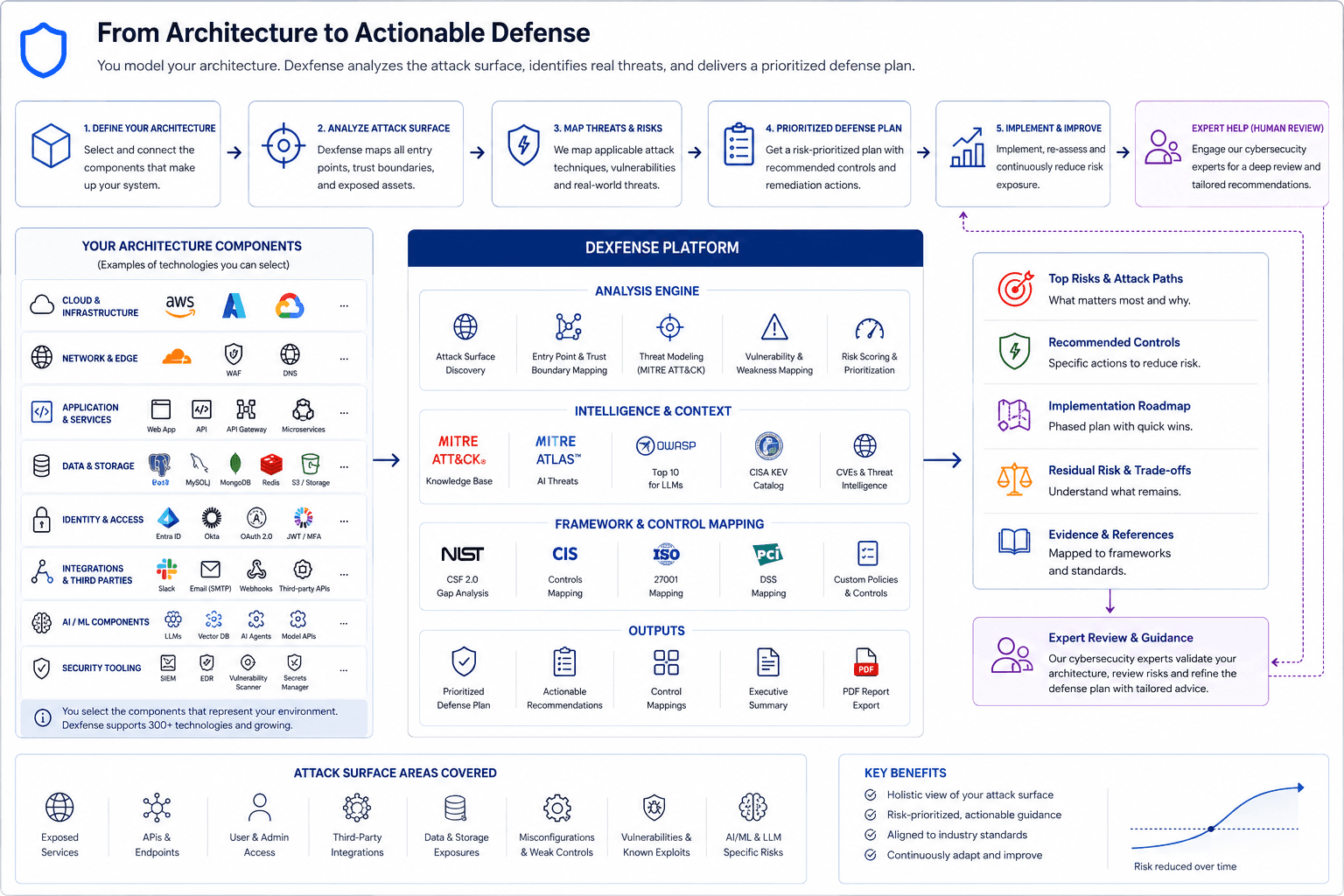
Dexfense maps your architecture to real threats and delivers a prioritised, exportable defense plan.
$4.88M
Average cost of a data breach globally in 2024
IBM Cost of a Data Breach Report 2024
194 days
Average time to identify a breach in 2024
IBM Cost of a Data Breach Report 2024
3.5M
Unfilled cybersecurity jobs worldwide in 2025
Cybersecurity Ventures / ISC² 2024
The threat landscape is growing faster than defences
According to the Verizon 2024 Data Breach Investigations Report, 68% of breaches involve a human element — phishing, credential abuse, or misconfiguration. Yet most organisations still lack a structured, component-aware view of their own attack surface.
The MITRE ATT&CK® framework catalogues over 600 techniques and sub-techniques used by real-world adversaries. Without a way to map those techniques to a specific system architecture, the framework's value is largely theoretical for practitioners who need to prioritise.
Dexfense bridges this gap: you describe your architecture, and the tool surfaces which ATT&CK techniques are most relevant — so effort goes where it is actually needed.
Most security plans are not architecture-aware
Generic security checklists and compliance frameworks treat all organisations as equivalent. A cloud-native SaaS startup and a legacy on-premise enterprise face fundamentally different threat profiles — yet both are often handed the same boilerplate control list.
NIST CSF 2.0, released in February 2024, explicitly calls for organisations to understand their specific attack surface before selecting controls. The framework's "Identify" function — the first of six — requires an accurate inventory of assets, systems, and the threats relevant to them.
Dexfense operationalises this: select your components, get a tailored risk profile, and export a NIST CSF 2.0 gap analysis that maps directly to your architecture — not a generic one.
The skills gap demands better educational tooling
The ISC² 2024 Cybersecurity Workforce Study estimates a global shortfall of nearly 3.5 million cybersecurity professionals. Junior practitioners and students often understand theoretical concepts but struggle to apply them to real infrastructure decisions.
Frameworks like MITRE ATT&CK and NIST CSF are well-documented — but their documentation is dense and not designed as a learning environment. A new analyst reading the ATT&CK matrix for the first time gains little intuition about which techniques matter for their environment.
Dexfense is designed to be both a professional planning tool and an educational platform: by interactively building a system and seeing threats surface in real time, practitioners at all levels build genuine intuition about attacker behaviour and defense priorities.
Structured planning reduces breach costs significantly
IBM's 2024 breach report found that organisations with high levels of security AI and automation saved an average of $2.22 million per breach compared to those without — and those with an incident response plan that was regularly tested saved a further $1.49 million.
The common thread: preparation. Organisations that had mapped their architecture, understood their threat exposure, and pre-planned their controls consistently outperformed those that reacted ad hoc.
Dexfense supports this preparation cycle. The exportable defense plan and gap analysis are designed to be living documents — reviewed before architecture changes, used in security reviews, and shared with stakeholders who need to understand risk in plain terms.
Who Dexfense is built for
Security Engineers & Architects
Map new or existing architectures to ATT&CK techniques and generate defense plans for internal reviews and board presentations.
Penetration Testers
Understand which components in a target environment map to high-value techniques before an engagement.
Security Educators & Trainers
Use as a live classroom tool to demonstrate how architecture choices directly affect threat exposure.
Students & Career Changers
Build hands-on intuition for MITRE ATT&CK and NIST CSF through interactive, architecture-driven exploration.
CISOs & Risk Officers
Generate exportable gap analyses tied to NIST CSF 2.0 functions to support governance and compliance reporting.
SOC Analysts
Understand which techniques are most relevant to your organisation's stack and prioritise detection coverage accordingly.
Key References
Now covering AI Agents & LLMs
AI agents — systems that combine a large language model with memory, tools, and external connectors — introduce a fundamentally new attack surface that traditional frameworks do not yet fully cover. Prompt injection, memory poisoning, tool abuse, MCP server compromise, and RAG data exfiltration are now real threats facing any organisation deploying autonomous AI workflows.
Dexfense maps these threats using techniques aligned with MITRE ATLAS and the OWASP LLM Top 10. Select AI Agent components — LLM models, agent orchestrators, MCP servers, RAG knowledge bases — and the planner surfaces the relevant attack techniques alongside concrete mitigations and detection methods.
Prompt & Indirect Injection
Malicious instructions via user input or retrieved content
Memory & Context Attacks
Poisoning agent memory and manipulating session context
Tool & MCP Server Abuse
Exploiting agent tool access and connector trust chains
RAG Data Exfiltration
Surfacing sensitive documents through conversational queries
Ready to map your attack surface?
Start with your architecture. Get a prioritised, exportable defense plan in minutes — free.
Open the Planner